LEARN ABOUT OUR INVESTMENT VEHICLES
Insights

LinkedIn
Safe Doesn’t Always Mean Secure
linkedin.com

Resource
Alina Trigub Podcast / The Power of Passive Investing
youtube.com
Entrepreneur to Investor: How To Build Wealth Without Working More/ The Power of passive Investing.

Blog
From Lehman to Lending: Lessons from a Real Estate Insider
youtube.com
On the Ready 2 Scale podcast, Sean Kelly-Rand breaks down how he scales real estate debt strategies with a focus on resilience, structure, and sustainable growth in volatile markets.
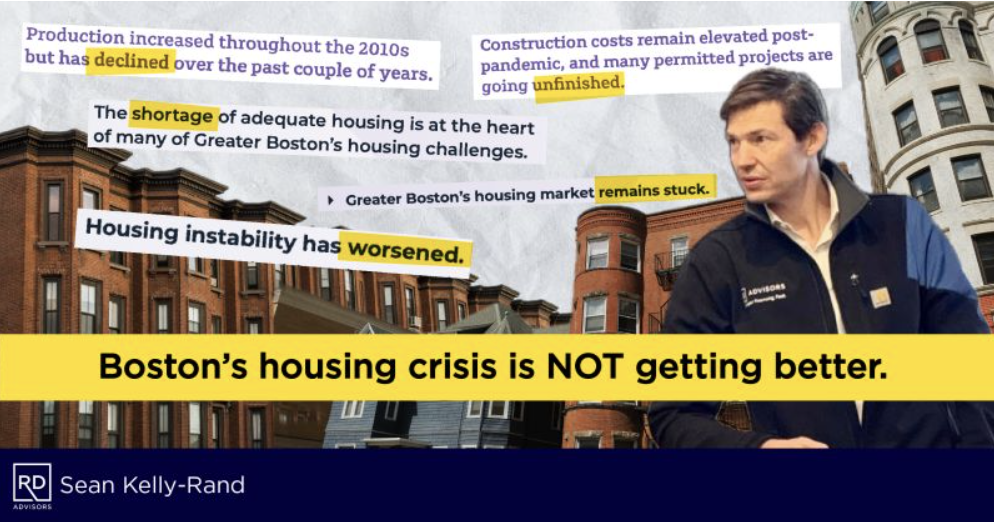
Boston Housing Crisis: 150,000 Units Short, Zoning and Permitting Issues
Boston has the 4th largest housing deficit in the US. And its not getting better.Here is the data:1) The Greater Boston area is short over 150,000 units for its population according to zillow.2) Under 6,000 new units were estimated to be delivered in 2024 by Moodys.3) Boston metro area saw a 38% year-to-date drop through March 2025, representing the largest decline since 2008!!!Let that sink in. Greater Boston area is 150,000 units short. It is not catching up, and even slowing down. If you are a resident of the area and wondering why you housing costs so much... it's pretty clear ... it's a scarce commodity. What can be done? We need to increase production substantially. The means clearing our the barriers. Right now the biggest are IDP (inclusionary development - i.e. the requirement that developers essentially build 1 loss making affordable apartment for approximately every 4/5 profitable apartments - that essentially stops most large scale construction). And two the zoning and permitting processes have become much longer over the past few years. Takes way too long to get shovels in the ground.Good news for home owners it helps keep home prices elevated. Bad news is its more expensive rents and harder to get on the property ladder. Let's Let the Builders Build!It also means there is loads of demand for loans from RD Advisors for rehab and bridge (renovation and conversion of existing, and soon mezzanine). And significant demand for housing when its built. Follow Sean Kelly-Rand on LinkedIn

LinkedIn
There’s a reason we’re in #Boston.
linkedin.com
Sean Kelly-Rand shares why he believes this market offers more stability for lenders—from its diversified economy to the advantages of nonjudicial foreclosures.

LinkedIn
Private Credit is Eating Private Equity
Private Credit is Eating Private Equity.Good quote by CP. I certainly don’t agree with everything he says but based on what we see in our own portfolio I find that statement to hold true.And this is exactly why we (myself and the Dominion Capital Family Office) partnered on a real estate private credit strategy eight years ago. The steadier stable private credit returns were likely to eventually overrun the more volatile equity/private equity returns over a longer period of time (Howard Marks writes on this as well).And I am sure this will be a topic at Milken Institute this week and SuperReturn in June.And too CP's point if private credit grows more than the equity side (i.e. less PE capital for acquisitions), than where does the debt/credit capital go…Well, if you follow me you are well aware of the wall of maturities, a massive gap in the capital stack, and how bank mergers and regulation are all leading to a massive need for private credit within the commercial and residential real estate sector.The opportunities are there and we’ll keep capitalizing on them.As usual this is not investment advice, merely boots on the ground observations from a real estate private credit specialist.Follow Sean Kelly-Rand on LinkedIn
Press and Speaking Engagements

Press
The Music Has Stopped For Once-Booming Real Estate Crowdfunding Platforms
bisnow.com
Once-booming real estate crowdfunding platforms are now teetering on the edge, with deal flow drying up, capital calls rising, and many earlier backers facing heavy losses.

Press
MassHousing Announces $5 Million in CommonWealth Builder Funding to Create 18 New Homes for Purchase by Moderate-Income, First-Time Homebuyers in Fall River
masshousing.com
McPherson Development LLC is developing the St. Louis Schoolhouse Condominiums at a former elementary school property.

Press
New Real Estate Debt Fund Set To Launch This Week
finance.yahoo.com
A new real-estate debt fund is being launched to capitalize on distressed opportunities in the property sector amid growing credit stress — positioning itself as a bridge financier in turbulent markets.

Press
BU Students Win $50,000 for Helping L.L.Bean Become More Eco-Friendly
bu.edu
A team of BU students won $50,000 and professional support through the Questrom Sustainability Competition by proposing ReBean, an eco-friendly resale platform to help L.L. Bean reduce waste and appeal to sustainability-minded buyers.

Press
thepitchboard.com
Sean Kelly-Rand discusses RD’s Real Estate Debt Fund II LP—its strategy, structure, and disciplined approach to generating strong returns through private real estate credit.

Resource
youtube.com
Managing Partner Sean Kelly-Rand was recently invited to speak at SuperReturn North America.